Silicon Valley's AI-Native Shift: Software Engineers Are Becoming Delivery Riders


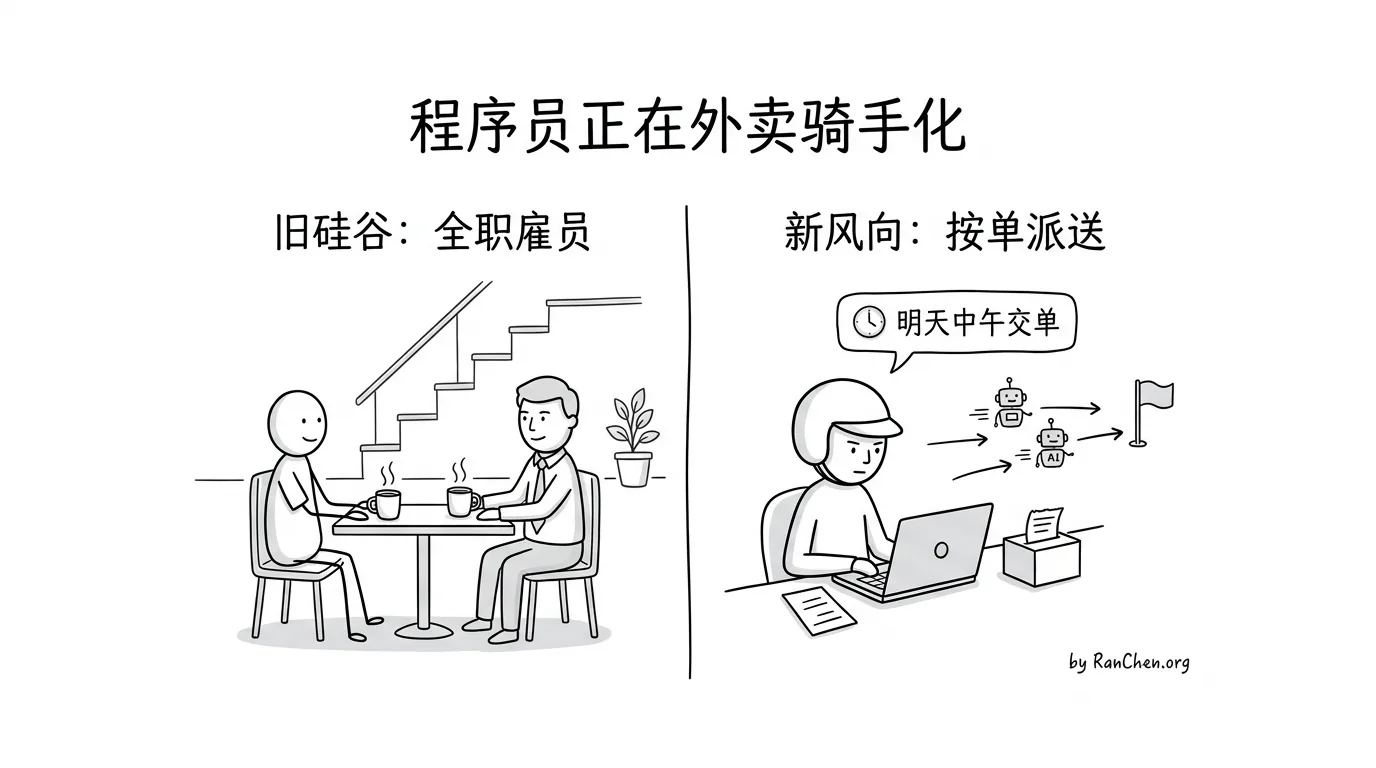
One late-November weekend evening in 2026, over drinks around a friend's dining table in South San Francisco, the conversation drifted from compute and stocks to how people are managing engineering teams today.
At the table sat a frontline engineering manager with twenty direct reports. In a matter-of-fact tone — as if commenting on evening traffic — he walked through his team's routine: five days a week in the office, status syncs scheduled on Friday evening and Monday morning, monthly feedback and stack ranking, forced bottom cuts every six months. If someone falls behind for two consecutive months, he checks in with the two peers who experience the most collaboration friction, gets a quick confirmation, and pulls his VP and HR into a three-person chat to terminate the relationship the same day.
The room went quiet for two seconds. Someone cracked a smile and joked: "And people still ask their manager about career growth? What's next — awarding Gold Rider, Platinum Rider, and Diamond Rider badges for food delivery?"
The whole table laughed.
When the laughter faded, I sat up a little straighter. Not because the joke was cruel, but because it punctured the polite veil Silicon Valley had been hiding behind for over a year.
In the summer of 2025, during a podcast recording and an internal team debrief, I first casually used the phrase "delivery-rider-ification." That August and September, I followed up with two short pieces — one arguing knowledge work would increasingly resemble driving Uber or delivering food, and another arguing full-time employment is disappearing as orgs split into partners and on-demand workers (both in Chinese). Even I thought it sounded slightly ahead of its time back then. Just over a year later, looking across San Francisco startups and South Bay tech giants at the end of 2026, what sounded like dark humor has become live operating policy.
Tech circles prefer a politer phrase: "managing employees like contractors." Inside real offices, though, that phrase is too diplomatic and academic. "Contractor" conjures independent consultants, outside counsel, or project specialists. The blunt sentence that actually captures Silicon Valley's AI-native shift is this: software engineers are becoming delivery riders.
Put a traditional full-time employee and a food delivery rider side by side — specifically, how an organization evaluates an employee versus how a platform evaluates a rider — and those jarring new Silicon Valley management practices stop looking like sudden cruelty. They look like arithmetic.
Evaluating an Employee vs. Evaluating a Rider: Two Completely Different Ledgers
When people hear "engineers are becoming delivery riders," their first gut reaction is emotional: how dare you compare $300k–$500k Silicon Valley engineers to gig workers braving rain on city streets? The comparison has nothing to do with pay. It is about the evaluation and transaction contract between individual and organization.
Recall how Silicon Valley tech companies defined and evaluated a full-time software engineer for the past twenty years.
In 1937, economist Ronald Coase asked a foundational question in The Nature of the Firm: if markets are so flexible, why invent companies to keep people under one roof long-term? Because market transaction costs are prohibitive. If a software company had to step onto the street every morning to find coders, negotiate prices, sign contracts, protect IP, and verify quality, nothing would ever ship. The three tests in the IRS worker classification guidelines — behavioral control, financial risk, and ongoing relationship with benefits — are essentially the legal codification of that bundled deal.
Translated into daily software engineering management, that deal produced the gentle order tech workers grew up in.
An engineering manager reasonably oversaw six to eight people, holding weekly 30-to-60-minute 1:1s to discuss not just deliverables, but morale, family stress, and next year's promotion packet. New hires got a three-to-six-month ramp-up cushion. Review rubrics spanned seven or eight elegant dimensions — technical depth, architectural vision, cross-team influence, collaboration, leadership potential. Even if production impact was thin in a given quarter, solid design docs, engaged meetings, and political alignment still earned "Meets Expectations." If performance slipped, the company ran a two-to-three-month Performance Improvement Plan (PIP) backed by dozens of pages of coaching notes.
See the underlying ledger? Traditional companies evaluated the person — long-term potential, visible effort, and organizational alignment. Companies bought exclusivity over your next several years and subsidized your learning curve because hiring capable programmers was brutally expensive, ramping domain veterans was slow, and coding was such a thick black box that leadership couldn't easily price individual lines of output.
Now pan to the street and look at how a delivery platform evaluates a rider.
Between platform and rider, nearly every buffer disappears. The system does not care what degree you earned, whether you feel burnt out today, or what your five-year career ladder looks like. Platform evaluation strips down to four stark rules:
- Atomic delivery, paid per order: Every job has an exact pickup, drop-off, and minute-by-minute countdown. What happens in transit is irrelevant — drop the bag at the door on time, tap confirm, and the ledger settles.
- Real-time transparent ranking: On-time rate, completion volume, complaints, response speed — scored continuously. Perform well and dispatch routes better, higher-paying orders to you; miss windows or draw complaints and you immediately get throttled or penalized.
- Zero onboarding obligation, zero ramp-up cushion: The platform assumes that the second you accept an order, you already know how to ride, know the streets, and own a charged bike and raincoat. Slow down or botch orders, and nobody spends three months coaching you — dispatch reroutes the next job in three seconds.
- Algorithmic dispatch plus ultra-thin station leads, eliminating warm middle management: No layered team leads, sub-managers, and mentors buffering emotions and managing upward; one dispatch engine plus a handful of operational nodes orchestrates hundreds of capacity units.
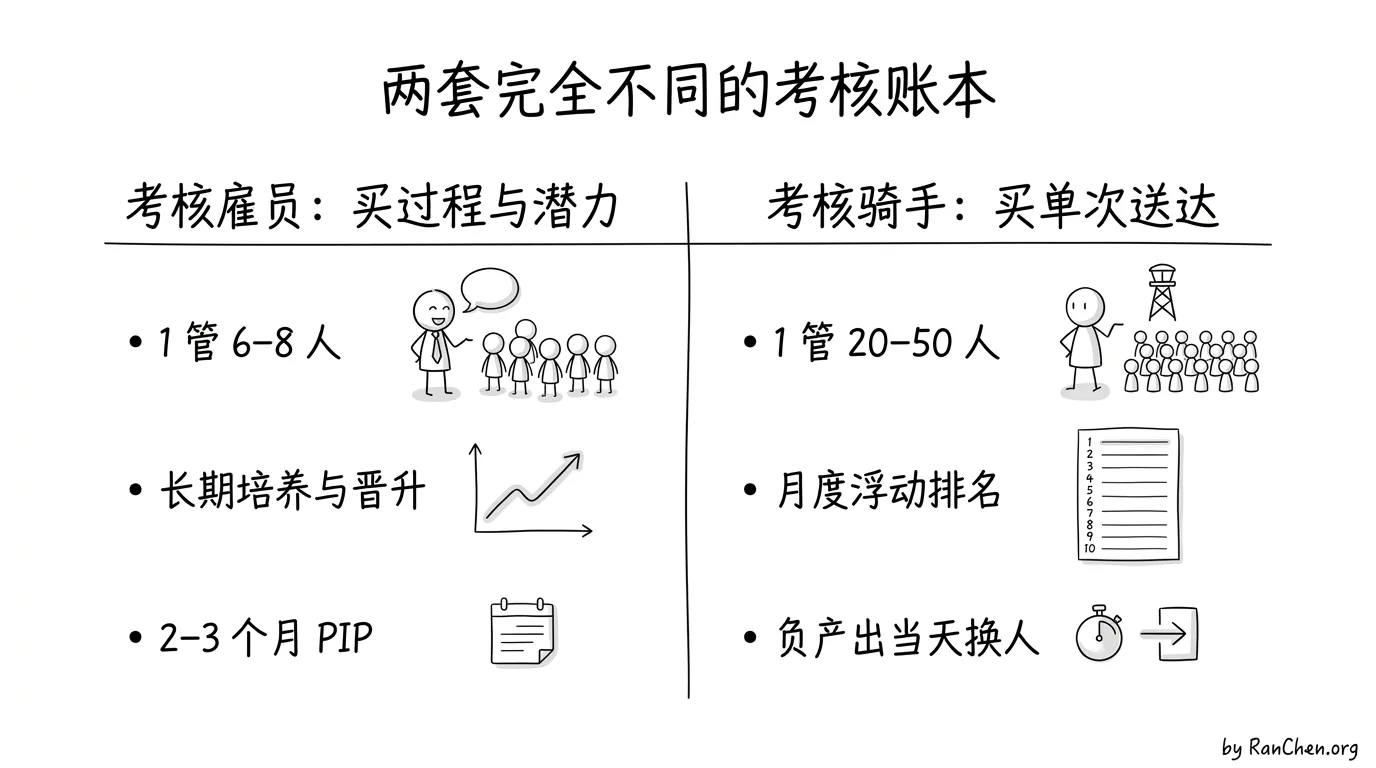
Lay those two ledgers side by side against Silicon Valley's most aggressive AI-native organizations today, and a sobering picture clicks into focus: they are importing the delivery-rider yardstick almost verbatim into six-figure engineering teams.
| Dimension | Traditional SV Full-Time Engineer | Delivery Platform Rider | 2026 SV AI-Native Engineer |
|---|---|---|---|
| What's Being Bought | Exclusive hours, process effort, long-term potential | Single completed drop-off (per order, on time) | End-to-end delivery measured in days and hours |
| Cadence & Yardstick | Semi-annual or annual review across multi-axis rubrics | Real-time piecework, late penalties, rolling rating | Weekly checkpoints, monthly feedback, rolling stack rank |
| Manager Role | 1:6–8 ratio covering delivery, morale, and promotions | Algorithmic dispatch; station lead handles exceptions | 1:20 to 1:50 ratio focused solely on goals & unblocking |
| Handling Underperformance | 2–3 month PIP focused on coaching and retention | Immediate throttling, lost dispatch, zero-cost swap | Confirm net negative, same-day exit, fast replacement |
In one crucial respect, today's high-pressure AI orgs are actually harsher than delivery apps. Gig riders retain two real freedoms: if you don't want to ride today, you don't open the app; if one platform cuts pay, you multi-app across two or three competitors at once. Many intense AI companies have imported the rider's low-cushion, per-deliverable, instantly replaceable evaluation ledger while holding tightly onto full-time exclusivity on the other side: full-week in-office mandates, high-intensity responsiveness, and zero side work. To persuade top engineers to sign that contract, frontrunners stack the opposite pan of the scale with high cash, high-upside equity, and uncapped access to frontier compute.
Inside Late-2026 Silicon Valley Offices: A Live "Dispatch System"
This is no longer an eccentric experiment at one rogue startup. It has filtered across Big Tech, unicorns, and lean startups until it is the ambient air of Silicon Valley.
The first thing to warp was the org chart and the engineering manager's calendar.
Back in October 2024, Gartner predicted that by 2026, 20% of organizations would use AI to flatten management layers and eliminate more than half of middle-management roles. Reality moved even faster. In September 2024, Amazon CEO Andy Jassy mandated raising the IC-to-manager ratio by at least 15% and stripping out "pre-meetings for meetings." In 2025, Google aggressively flattened middle management, removing managers of managers and pushing small-team leads back into coding. By spring 2026, Fortune reported Meta piloting 50-to-1 flat spans in applied AI engineering — and a month later named the emerging archetype: the "Megamanager."
At an alumni lunch in the Bay Area this March, Big Tech friends described that 1:50 pilot firsthand. All fifty reports were flattened into one generic title — "AI Builder" — and even product managers had to re-interview to justify their seats.
Elementary arithmetic tells you what 1:20 or 1:50 does. With six direct reports, spending five hours a week in 1:1s lets you remember whose kid started kindergarten and who feels stuck on a promo case. Put twenty people under one manager, and calendar math physically kills nanny-style management.
A common pattern across high-pressure Bay Area teams is slicing twenty engineers into six or seven tiny pods of two or three focused on concrete deliverables. The manager syncs weekly only with pod leads; everyone else gets a 1:1 every three or four weeks. Tellingly, many leaders deliberately refuse to grant formal "manager" titles to strong leads, preferring they informally pull in trusted referrals and ship together. One frontline manager put it bluntly to me: team leadership should rotate dynamically with the mission — the moment you stamp "Manager" on someone's title, too many people slide from getting things shipped back to defending turf and inventing process. Even managers themselves increasingly resemble roaming station leads: drop into whichever operational fire needs stabilizing, put it out, and rotate to the next front.
Once spans widen, what takes over daily cadence is an hour-level "delivery countdown."
In August 2025, after acquiring the Windsurf team, Cognition CEO Scott Wu sent a stark internal memo declaring the company did not believe in work-life balance, expecting six days a week in office and 80+ hours — or nine months of severance to walk away. Both The Pragmatic Engineer and Forbes in early 2026 documented the end of San Francisco's "work hard, play hard" playground era.
At the team level, the countdown feels even sharper than the slogan "996." Multiple intense engineering groups I know nominally run five days a week in office with no official weekend clock-in — yet pin status syncs to Friday evening and Monday morning. As one bystander laughed: "It's like school letting out for summer break, with a pop quiz scheduled for the very first second back." Daily check-ins no longer ask vaguely "How's this week going?" They anchor to the hour: "Where will this stand when we sync tomorrow at noon?" A pod lead who cannot articulate next week's single sharpest deliverable is immediately read as checked out.
When software delivery shrinks from quarterly roadmaps to "ship by noon tomorrow, pop quiz Monday morning," office tempo converges with the countdown timer on a delivery rider's phone.
Performance yardsticks are shifting along the exact same track.
In the first half of 2026, Big Tech briefly ran an almost surreal experiment: if everyone must use AI, how do you measure who is grinding hardest? At that March lunch, friends vented about internal AI token-burn leaderboards — whoever burned the most tokens climbed the dashboard and looked better in reviews, a phenomenon dubbed "Tokenmaxxing." Absurd as it sounds, isn't that identical to early gig platforms scoring riders on hours online and miles logged? Predictably, gaming exploded: engineers ran agents in pointless loops to pad stats while internal compute bills surged. By autumn 2026, Meta executives issued a memo stripping token counts and AI usage dashboards out of performance reviews, snapping evaluation back to four hard pillars: output quality, delivery speed, problem complexity, and scope of ownership.
After a full detour, measurement landed somewhere even colder and simpler: whether or how you use AI is your problem; the platform only grades whether you land hard orders at the door fast and intact.
On faster frontline teams, adjective-packed eight-dimension rubrics have fallen out of favor. One engineering leader summed up the only two blades that actually cut: hour-level deadlines and monthly floating stack ranking. No more gentle "mostly meets expectations" grading — managers must force-rank ten reports from #1 to #10, then answer a pointed question about #9 and #10: "You just admitted these two are the weakest on the team. Why are they still here?"
Ever since Mark Zuckerberg moved in early 2025 to cut roughly 5% for performance while continuing to backfill, Big Tech turned once-in-a-downturn layoffs into continuous roster churn. Inside high-intensity AI teams in 2026, the traditional two-to-three-month, 30-page PIP is rapidly going extinct.
I heard one minimalist exit protocol described firsthand: monthly feedback, semi-annual bottom cuts. If someone misses the bar two months in a row, the manager doesn't draft an essay — they ask the two teammates with the most collaboration friction one razor-sharp question: "Is this person currently net negative?" In plain English: if that desk is empty tomorrow, does the team move faster? Two nods go straight to HR; manager, VP, and HR open a three-way chat and wrap up the employment the same day. Even 1:1s shift from emotional support into a friction radar hunting for bottlenecks. Counterintuitively, on dense high-performer teams this ruthless clarity often boosts morale: strong builders rarely hate working hard; what drives them crazy is sprinting beside a chronic drag while leadership plays peacemaker. Once they see real blockers get cleared fast, builders actually feel relief.
I also heard a hiring-and-retention red line sharper than any rubric:
A hard problem lands on your desk, and normally it belongs to a certain engineer — yet every time you picture them, you instinctively hesitate to hand them hard work. The second that reflex shows up, trust is already at zero, and it's time to part ways.
Over a decade ago, Netflix's famous culture deck shocked Silicon Valley by declaring "We're a pro sports team, not a family" and introducing the Keeper Test. Yet pro sports teams still have seasons, farm benches, and dignified trades. Around that South SF table, someone blurted out an even truer label for 2026: bounty hunters — or simply per-order riders.
Along with it, two sacred phrases of old corporate culture — "career development" and "employee motivation" — have lost their spell. One seasoned engineering leader shared a cold heuristic: employees who constantly pull their boss aside to talk about career paths, learning room, or fish for "any recent feedback?" are usually feeling shaky because they haven't shipped enough; people delivering undeniable work know exactly where they stand and run on self-propulsion, needing zero pep talks.
Even everyday legal markets in the Bay Area mirror the same shift. A friend dealing with a home-purchase seller dispute told me his first lawyer billed hourly — invoices stuffed with research, emails, and redlines, overflowing with "activity" while the case sat frozen for over half a year. He bit the bullet and switched to a contingency lawyer paid a percentage of the final settlement. Once incentives aligned, the performance theater vanished, and the lawyer secured a six-figure settlement quickly. Tech companies used to retain engineers like hourly lawyers; today they want riders paid on delivery.
How Did We Actually End Up Here?
Blaming all of this on "meaner Silicon Valley CEOs" or "a bad job market" misses the real story. Software engineers did not turn into delivery riders overnight. Four interlocking structural forces spent the past few years dismantling the old employment contract piece by piece.
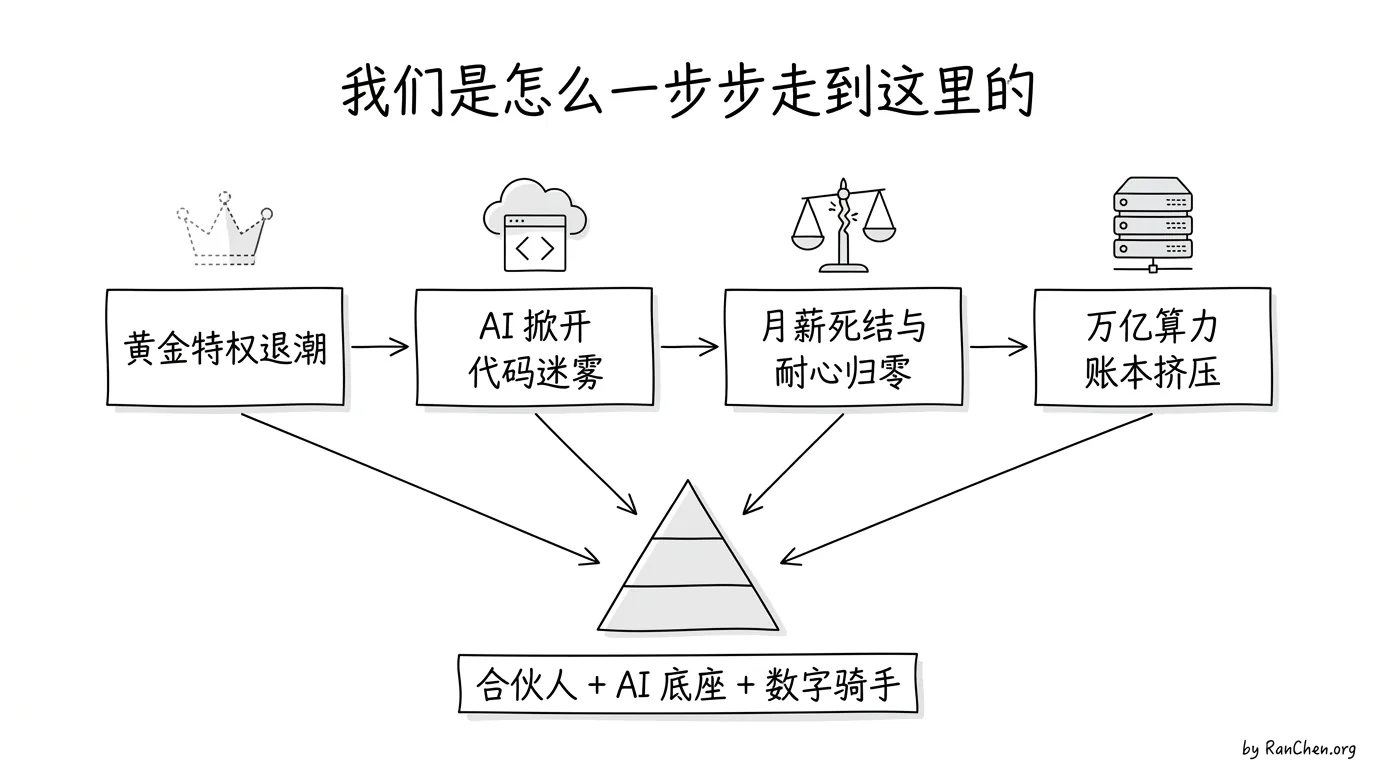
Twenty Years of Gentle Privilege Was Always a Historical Anomaly
Zoom out across industrial history and this exact movie has played on repeat.
In a summer 2025 internal debrief, I reminded my team of that historical arc: every wave of engineering enjoyed the same golden ascent and normalization. During the steam and industrial machinery boom, mechanical engineers were prized aristocrats; when the auto industry took off, automotive engineers commanded high pay and prestige. As toolchains standardized and training pipelines scaled, every sacred craft eventually shed its halo and repriced into a normal market occupation.
Between 2000 and 2022, software engineers caught an unprecedented double tailwind: near-zero marginal-cost software gross margins that easily funded thick middle management, free meals, shuttles, and long ramp cushions; plus a deep technical black box where people who could wire complex systems were genuinely scarce, forcing firms to court them with high pay and generous insulation.
In Ordinary People in Silicon Valley (in Chinese), I unpacked the collective illusion of two generations of Bay Area engineers: twenty smooth years fooled people into mistaking an extraordinary industry Beta for a permanent law of labor protection.
Before a panel last September on whether "Silicon Valley 996" is even legal, I went back to the US Department of Labor primary statutes. Many observers abroad assume US labor law heavily restricts white-collar hours. The opposite is true. Under DOL Fact Sheet #17E on computer-related occupations, most salaried software engineers — like doctors, lawyers, and CPAs — are overtime-exempt. Combine that with standard at-will employment across California and the US, and demanding 60–70+ hours a week or terminating employment at any moment has always been legally wide open. Wall Street banks, BigLaw firms, and Big Four accounting firms have operated that way for decades. Silicon Valley stayed gentle for twenty years not out of legal benevolence, but because talent was scarce and capital flowed fast. The moment those two pillars cracked, the hard commercial bedrock underneath snapped back into view.
AI Lifted the Fog Around Code, Making Software Piece-Measurable for the First Time
Why can delivery apps turn riders into per-order, real-time-ranked capacity units? One precondition: radical delivery transparency and unambiguous verification. When food leaves the kitchen, which street the rider is on, the exact minute it hits the doorstep, whether soup spilled — everything is visible in the backend with zero gray area.
For twenty years, software engineering couldn't be managed that way because the fog of implementation was too thick. Scoping, environment setup, boilerplate, integration debugging, legacy debt, cross-team alignment — every layer acted as natural camouflage. An engineer with modest political savvy, clean design docs, and a knack for making complexity sound bottomless could coast comfortably in Big Tech for a year on "visibly busy process" despite thin actual output.
AI blew that camouflage away.
The sharpest perk top AI labs and startups hand engineers today isn't massage chairs or micro-kitchens — it is uncapped access to frontier compute. As someone still writing code myself, my personal consumption now runs tens of billions to 100 billion tokens a month. Once you deploy coding agents on real production repos, you collide immediately with what I called out in What Matters and What Doesn't: Intellectual Honesty in AI Coding (in Chinese): raw implementation just got cheap.
When a feature took two weeks, fuzzy thinking hid comfortably inside slow meetings, reviews, and rework. When AI spits out code overnight, delivery compresses to days or hours. Once everyone wields the same tooling leverage, skill gaps turn glaringly transparent. Within two or three weeks of working together, everyone sees who truly understands system boundaries and can steer AI to ship reliable software — and who merely dumps half-baked agent output onto main and leaves cleanup wreckage behind.
That transparency is even flipping technical interviews upside down. A friend who regularly interviews engineers in the Bay Area told me his biggest hiring fear today is a new AI-era breed of "pseudo-senior": heavily reliant on generated code, fluent in lofty architecture buzzwords, oozing confidence — until production breaks and two probing questions about root cause or underlying mechanics expose a blank stare. In response, more teams are abandoning memorized LeetCode tricks and asking candidates to code Tetris or Snake live from scratch, testing raw code intuition and clear cross-functional explanation. Put bluntly, a dispatch platform doesn't care if you can give a keynote on logistics strategy — it cares whether you can actually steer the bike without crashing. Pass the basics, get uncapped compute, and prove it on the road.
Fixed Salaries Break Under 10x Leverage, and Managers' Patience Baseline Collapsed
Once code becomes transparent enough to verify daily, a structural fault line buried inside full-time salaried employment snaps wide open.
In The Disappearance of the Full-Time Employee (in Chinese), I laid out the incentive mismatch: traditional salaried employment buys time linearly, while AI scales output exponentially.
Run the simplest math: if a salaried engineer uses AI to finish five days of work in one day, does their paycheck multiply by five? No. At most companies, three things happen instead: their queue gets refilled immediately, their perceived scarcity drops, or leadership realizes a five-person squad now needs two people. Inside a fixed-salary box, the rational move for a worker is rarely pushing AI to obliterate legacy workflows; it is cultivating "safe busyness" — quietly using AI to finish faster, smiling through company workshops and hackathons for a cheerful round of Happy AI Transformation, and carefully preserving legacy complexity and job security underneath.
At the same time, managers' psychological baseline has collapsed.
Over the past year and a half, I personally led deep system and organizational rebuilds, tearing down legacy pipelines from scratch. That experience pushed me to write AI Killed My Tolerance for Stupidity (in Chinese). AI didn't just accelerate coding; it violently reset every leader's internal threshold for how long I am willing to wait for someone to understand me and gradually improve.
When you work with AI, you encode context into your repo and knowledge base, point out a mistake, and it shows zero ego, zero defensiveness, and zero turf wars — it fixes the issue in minutes, and every correction compounds permanently into the codebase. Once that becomes your daily baseline, turning back to a traditional employee who waits passively for Jira tickets, stalls if one line of a spec is missing, repeats the same error after three explanations, and turns every conversation into one-off emotional overhead amplifies frustration tenfold.
As I laid out plainly in You Don't Like Your Company, and Your Company Doesn't Need You (in Chinese): companies never fundamentally needed people — they needed specific business functions completed. Previously, completing those functions required carrying deep hierarchies, long ramps, and heavy emotional coordination costs. As AI slices down execution and communication costs, leaders realize that rather than pouring endless energy into persuading, soothing, and motivating misaligned full-time staff, it is far cleaner to modularize the system, lock the bar, verify outcomes directly, and swap fast when someone misses.
Trillion-Dollar Capex Squeezed Out the Last Drop of Sentimentality
If the first three forces built the foundation of the rider system, the 2025–2026 capital expenditure bill hanging over Silicon Valley flipped the master switch.
Over the past two years, tech giants and capital markets poured staggering sums into chips, data centers, and frontier models — compute capex at many giants now rivals or eclipses traditional R&D, shifting dollars massively from payroll to GPUs and power bills. By 2026, both Wall Street and enterprise buyers had grown tired of soft pitches about "AI lifting employee efficiency 10%" that never show up on the P&L. At Bay Area dinners, friends sitting near core finance and tech supply chains state the math bluntly: that mountain of capex carries real cost of capital. Talking about incremental efficiency no longer matters — cutting headcount and driving 10x revenue per person is now the line between living and dying.
Pressure squeezes from top and bottom simultaneously.
From the top, leaders explicitly cap headcount. In April 2025, Shopify CEO Tobi Lütke put it in writing: before requesting any new headcount, teams must prove why AI cannot do the job. Meanwhile, a new wave of AI-native startups shattered old productivity benchmarks: in early 2026, Swedish coding platform Lovable reported adding $100M in incremental revenue in a single month with just 146 employees, alongside teams like Cursor and Midjourney generating hundreds of millions to billions with dozens or hundreds of staff.
From the bottom, incumbents face existential competition. As I wrote in 2026: The Final Layoff Window for Enterprises (in Chinese), when tiny teams operating at 1% of incumbent overhead put AI-armed engineers directly in front of customers, any legacy organization still carrying thick middle layers and six-month onboarding cycles gets crushed on both cost and speed.
Even the external labor market is sprouting matching "rider platforms." One of Silicon Valley's fastest-growing categories over the past year is AI training data and domain-expert evaluation networks, paying top specialists $200 to $500 an hour. At a recent dinner, a friend close to that space mentioned full-time tech engineers quitting salaried jobs to work exclusively as task-based experts: no commute, no meetings, no office politics — deliver per task and out-earn a full-time role.
Once all four forces converge, the skeleton of Silicon Valley's new organization becomes unmistakable: at the top, a tiny circle of equity-holding Business Owners who know customers, make hard calls, and own the endgame; in the middle, no longer layers of middle managers, but 24/7 AI agents and machine-readable knowledge bases; on the outer ring, heavily compute-armed "digital riders" graded monthly on delivery, rotating in and out fast.
Trapped Inside the New System: Why Using More AI Feels More Suffocating
The institutional gears have already shifted; the people absorbing the shockwave are the engineers sitting in front of monitors every day.
Over the past few months, grabbing coffee and jumping on calls with senior engineers across Silicon Valley and China, I keep hearing the exact same exhaustion. Researchers and consultancies have now given it formal names: in February 2026, two UC Berkeley Haas scholars published an eight-month field study of ~200 US tech workers in Harvard Business Review, finding AI did not shrink workloads — it erased rest boundaries and cranked intensity higher. A month later, BCG surveyed 1,488 full-time US workers and coined "AI Brain Fry," showing cognitive fatigue surges once workers simultaneously supervise more than three AI tools.
In Mindfulness and Meditation Cannot Save Knowledge Workers in the AI Era (in Chinese), I quoted senior engineers juggling three or four coding agents at once all day — bouncing violently across terminal panes, multiplying nominal code throughput while feeling like a frantic switchboard operator passing notes between windows. Closing the laptop at midnight brings not pride, but a strange hollowness.
That suffocation comes from the exact same root as China's viral essay Delivery Riders, Trapped in the System — except with an even crueler twist.
After recording that podcast last year, I shared a counterintuitive observation with the host: talk to street delivery riders or Uber drivers, and while they complain bitterly about platform take rates and tight algorithms, many are actually calmer psychologically than white-collar workers venting about their bosses in glass towers. Why? Because riders understand the contract from day one: I run a delivery, I get paid for that delivery; the platform is not my family, and I never expect it to map my five-year growth or underwrite my future. Clean expectations produce clean transactions.
Most Silicon Valley and Big Tech engineers today are pinned inside the worst possible gap: companies have already switched to a gig-platform evaluation engine — monthly output counts, hourly deadlines, instant replacement for net negatives — while employees' emotional expectations and household balance sheets remain bolted to the 20-year-old "lifetime employee" template.
Mortgages, tuition, family health insurance, work visas, and social identity are all welded to a single employer's direct deposit. So you endure rider-level pressure and replaceability anxiety without the true contractor's freedom to serve multiple clients or walk away from one platform at will. Worse still, no matter how fast a delivery rider pedals, they rarely accumulate repeat customers or a brand of their own. Likewise, an engineer orchestrating five agents inside a company to crush internal tickets walks out the door without direct customer distribution or an independent revenue loop — and if the org flattens one more layer tomorrow, they simply sign up on the next dispatch app.
Stop Chasing the "Diamond Rider" Badge
Come back to that South San Francisco dining table and the joke that cracked everyone up: "What's next — Gold Rider, Platinum Rider, and Diamond Rider badges for food delivery?"
It stung because it exposed a plain truth: inside a dispatch system, tier badges are never a moat — they are carrots the platform dangles to make you pedal faster. Grind all the way to Diamond Rider, and the algorithm still sets the rate, tightens the routes, and treats you as a swappable node the day a better tool or cheaper rider arrives.
The delivery-rider-ification of software engineers is not a temporary mood swing at a few Bay Area startups. It is the irreversible gravitational pull of AI making code production transparent, piece-measurable, and cheap.
Seeing the new board clearly isn't a reason for rage or quiet quitting. It is a reason to run the math early and stop wasting years on two losing plays.
First, reframe the job cleanly as a transaction and quit projecting emotional loyalty onto the platform. As I wrote in Taking a Job Is Also an Active Choice: A or B, Not B or Not B (in Chinese), high cash, health coverage, frontier compute, and live business problems at top tech and AI firms are strong chips. If you choose to sit at that table, ship undeniable results and never become the person your manager hesitates to hand hard work to — while letting go of the fantasy that a megamanager overseeing twenty people is going to architect your five-year growth.
Second, the only way out of the rider trap is to stop being pure execution capacity and build an asset you actually own. In any delivery chain, pure A-to-B execution capacity is always the most fragile link — every tool upgrade reprices it downward. Durable leverage belongs to the restaurant owners and partners who hold customer trust, own distribution, and take responsibility for real commercial outcomes. While a steady paycheck still gives you runway, give yourself a patient one-to-two-year horizon to move closer to real customers and close even a small independent loop that answers to no single employer.
Just like mechanical engineers a century ago and automotive engineers seventy years ago, software engineers' golden twenty years of black-box scarcity and thick institutional cushioning are quietly drawing to a close.
Eras never send advance notice when they shift gears, and nobody is singling out programmers out of spite. The dispatch backend simply pushed a new algorithm. Understanding how it scores and settles accounts today — and refusing to bet your entire life on a rider badge that can reset to zero overnight — may be the most urgent lesson every software engineer needs to learn right now.
Continue Reading
All content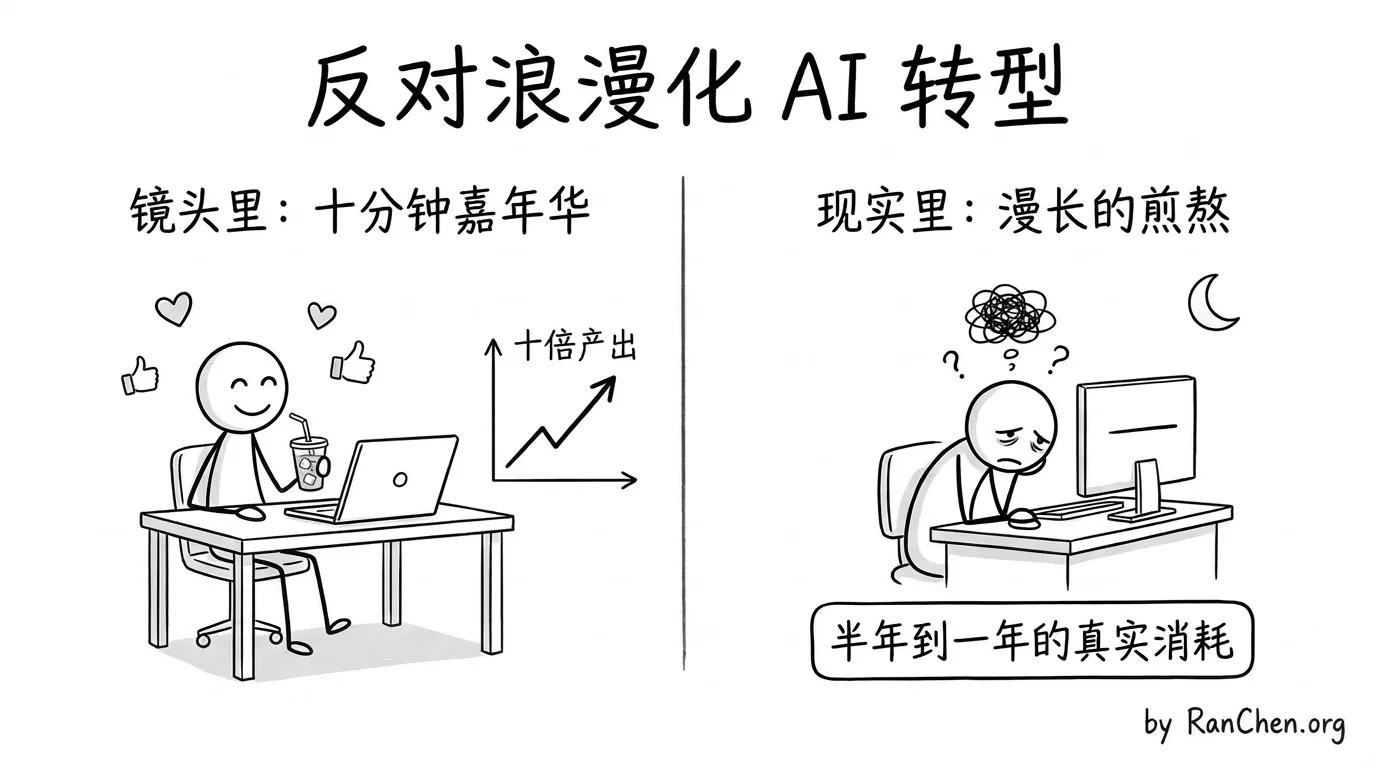
Why I Oppose Every Effort to Romanticize AI Transformation
Real AI transformation is not a 10-minute demo video or a heroic battle. It is 6–12 months of zero positive feedback for individuals, sleepless paralysis for CEOs, and relentless context switching for surviving employees. Be realistic.
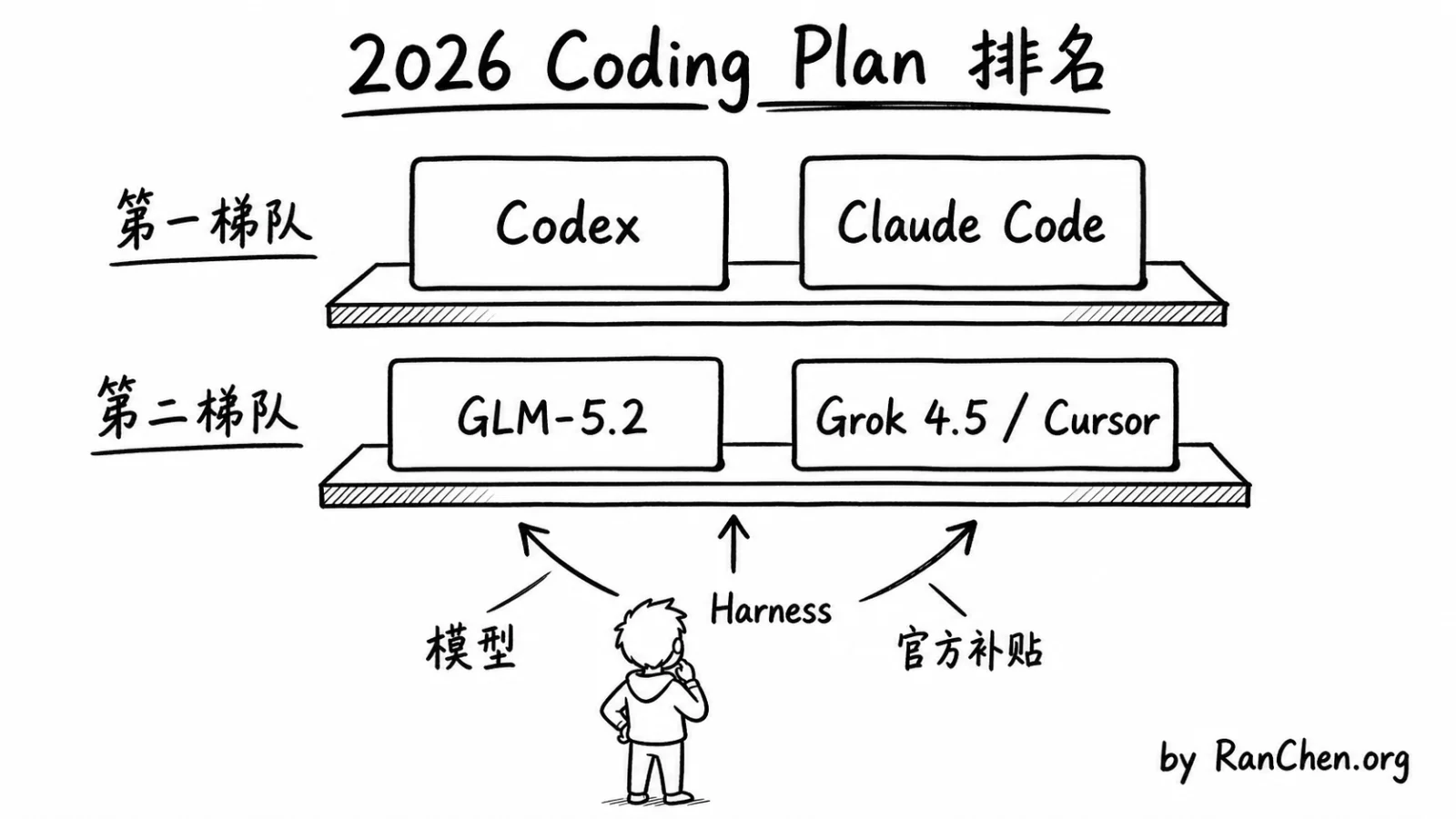
2026 AI Coding Plan Comparison & Ranking: Claude Code, Codex, Cursor, and Real Monthly Costs
How I rank 2026 AI coding plans across model capability, agent harness, and vendor subsidies — burning 50–100 billion tokens a month across Claude Code, OpenAI Codex, SuperGrok, Cursor, GLM-5.2, and Gemini.